


Financial Markets
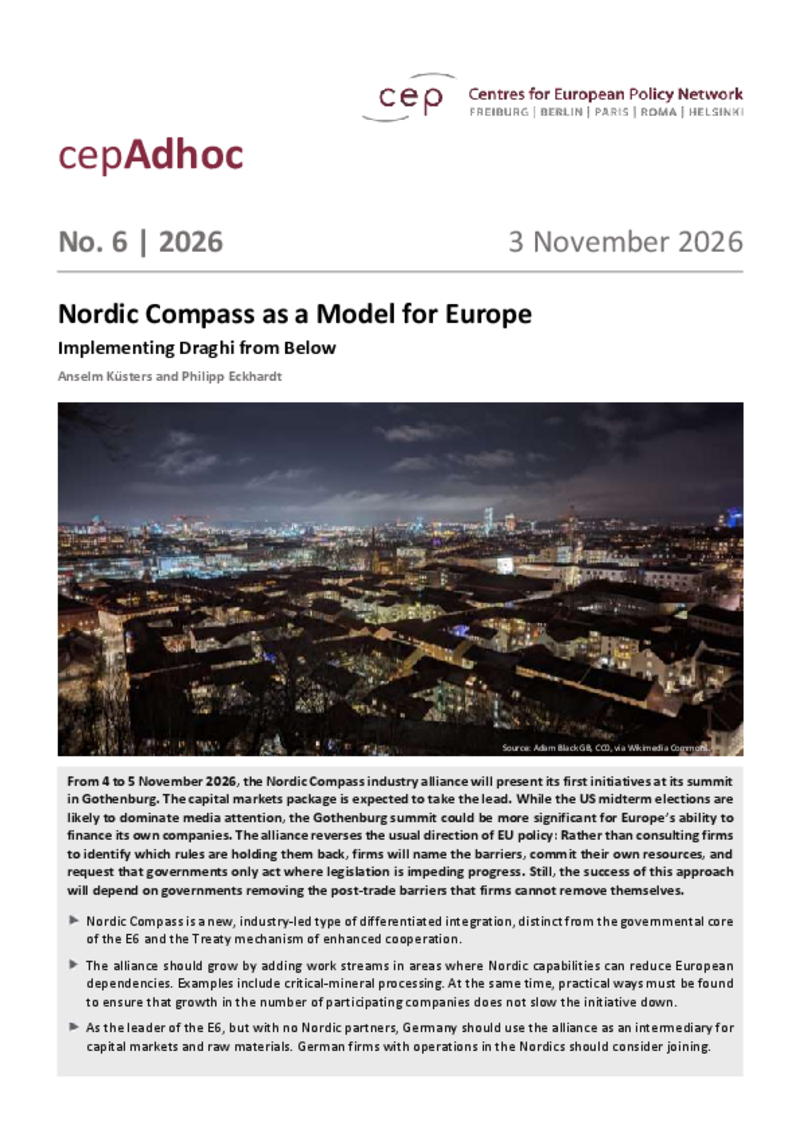
Nordic Compass as a Model for Europe
Published on 11.03.2026


cepAdhoc
Two years after the Draghi report, Europe has no shortage of diagnoses but lacks implementation. In Brussels, the Commission consults, legislates, and then aims to simplify. Nordic Compass turns this sequence around: companies first ask what they can change themselves, and governments are called upon only where the law stands in the way. ‘In the Nordic countries, competitiveness is not an end in itself but the economic basis of the welfare state,’ says Anselm Küsters, Scientific Director of cep Nordic Countries. ‘Small open economies have always had to organise scale across borders. Nordic Compass applies this Nordic habit to Draghi’s agenda.’ While German debates on competitiveness usually end with a demand addressed to Berlin or Brussels, Gothenburg offers a different starting point: firms that first ask what they can change themselves.
The capital markets track is expected to take the lead at the alliance’s first summit. Nordic pension funds and sovereign investors manage close to USD 4 trillion; in Denmark, pension assets amount to 192 per cent of GDP, in Germany to just 12 per cent. Yet this capital remains split across national markets. ‘A common Nordic exchange would attract the headlines. But whether a Swedish pension fund buys a Finnish small cap depends on withholding taxes or common investment and insolvency rules, too,’ says Philipp Eckhardt, Head of Department Financial Markets and Information Technologies at the cep. ‘Designed as an early user of the EU’s planned pan-European market operator licence, a Nordic venue could show that the Savings and Investments Union works in practice,’ says Eckhardt. A merger of the exchanges would also be an early test of the Commission’s revised Merger Guidelines.
For Germany, the initiative could provide a valuable group of strategic partners. Berlin is currently pursuing speed through the E6, which does not include any Nordic states. By contrast, Nordic Compass is open in principle to companies active in more than one Nordic market, including German firms. ‘The debate on a Europe of different speeds has so far been a debate among governments,’ concludes Küsters. ‘Gothenburg shows that speed can also come from below. Germany would be well advised to use both routes, starting with capital markets and critical raw materials.’
Download PDF
| Nordic Compass as a Model for Europe (publ. 11.03.2026) | 629 KB | Download | |
 | |||