



Artificial Intelligence
Europe’s Compute Gap and the Data Centre Backlash

cepInput
Currently, Europe accounts for less than five per cent of global AI computing power, whereas the US accounts for around 75 per cent. ‘The gap between demand and available data centre capacity in Europe could rise from three gigawatts to 14 gigawatts by 2030,’ says Anselm Küsters, Scientific Director of cep Nordic Countries. Europe is also lagging behind in terms of construction speed: in Germany, for example, it takes an average of around 42 months to build a data centre, compared with around 24 months in the US. In some cases, Chinese operators are completing 100-megawatt facilities in less than twelve months.
Finland demonstrates how faster procedures and site planning can facilitate investment. However, even there, pressure on grid operators is mounting. ‘Building new facilities where electricity is generated rather than where it is consumed cuts connection times by years and reduces the need for new power lines,’ says Küsters. The cep recommends prioritising grid connections based on capacity and intended use. To ensure European technological sovereignty, the cep also suggests a targeted division of labour. Given their energy and climate conditions, the Nordic countries could become preferred locations for training large AI models. Meanwhile, Germany should expand its computing capacity for industrial AI applications mainly where latency is critical.
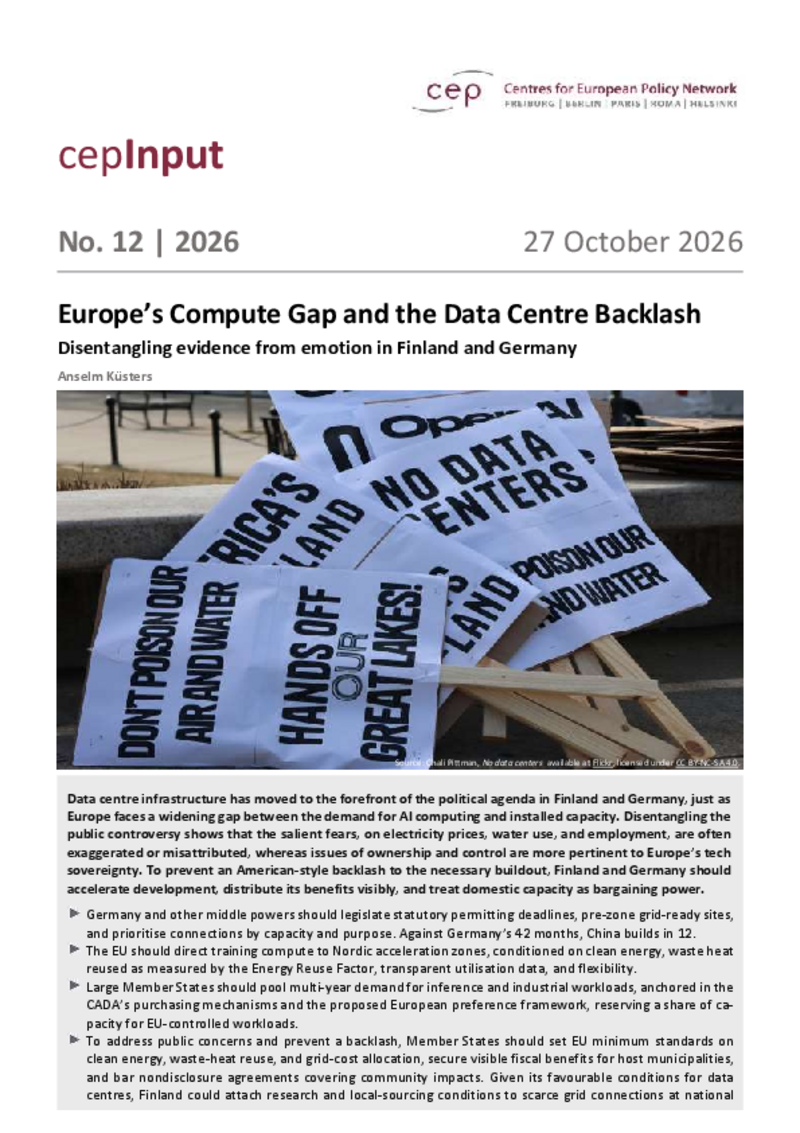
The study also examines the growing protests against data centres in both countries. Empirical research only partially supports concerns about rising household electricity prices or high water consumption. However, more relevant are issues of ownership and local distribution. Host communities must derive tangible benefits, for example through the business tax redistribution scheme planned by the German government. Agreements between operators and local authorities should also be publicly accessible. ‘Europe cannot afford the emotional intensity of the US debate,’ concludes Küsters. ‘A division of labour between Nordic computing capacity and German industrial demand, embedded within common EU standards, would be a pragmatic path towards greater technological sovereignty.’
Download PDF
| Europe’s Compute Gap and the Data Centre Backlash (publ. 10.27.2026) | 777 KB | Download | |
 | |||