
Information Technologies
Digital Networks Act Part 1


cepPolicyBrief

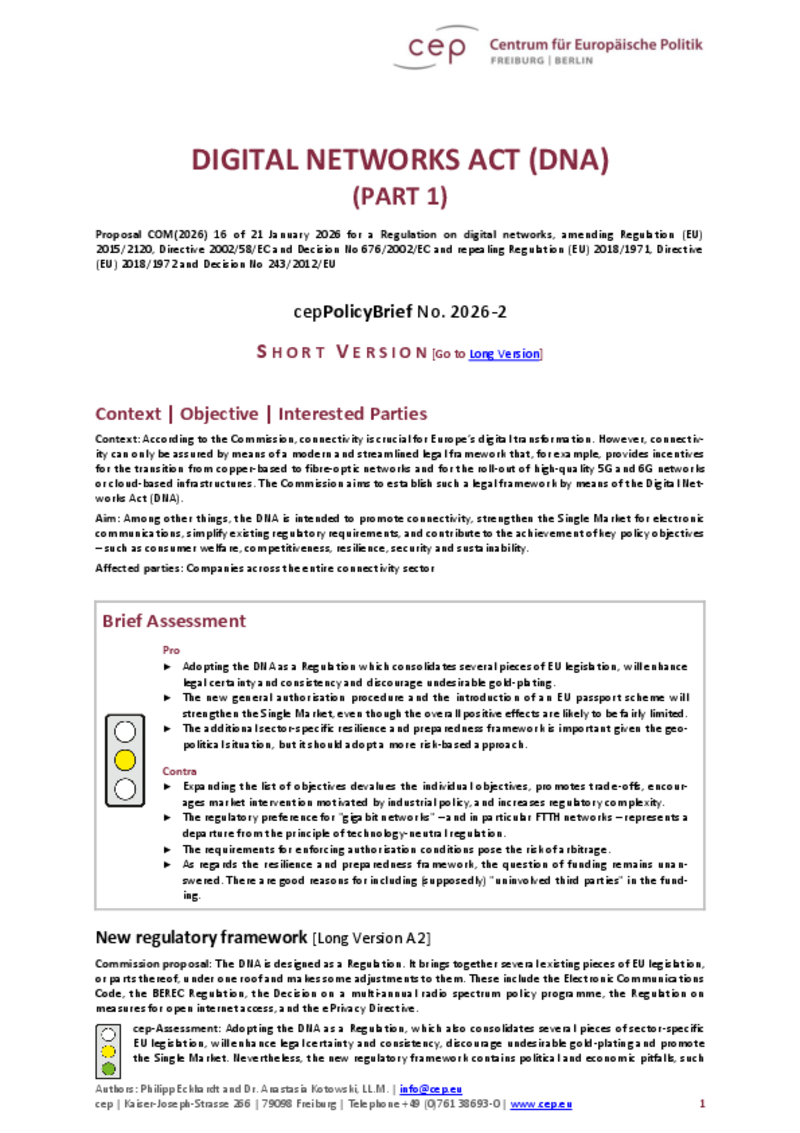
The authors of the cepPolicyBrief, Philipp Eckhardt and Anastasia Kotowski, consider the approach of bundling several legal acts within the DNA and enshrining the act as a regulation to be particularly sensible. This can strengthen legal certainty and the single market. However, they warn: “In the political negotiation process, this approach should not be misused for package solutions that are of little practical use.”
In contrast, the expansion of the catalogue of regulatory objectives is, in the view of Eckhardt, an economist at cep, misguided. In future, the strengthening of competitiveness, sustainability and resilience is also to be included in the already lengthy catalogue of objectives. “The expansion may seem politically expedient,” says Eckhardt. “However, it paves the way for additional conflicts of interest, increased regulatory complexity and less predictable regulation. There is also a risk of unnecessary market interventions motivated by industrial policy.”
Eckhardt considers the establishment of a new framework to strengthen resilience and preparedness specifically for the digital networks sector to be understandable given the broader geopolitical climate. “However, the framework must be designed to be even more risk-based, integrated more closely with existing EU regulations, and the financing issue clarified at an early stage,” demands Eckhardt. Anastasia Kotowski, a lawyer at cep, warns, however: “The resilience framework poses jurisdictional problems where the proposal goes beyond traditional single market regulation and touches on areas of state security and crisis preparedness. The provisions on crisis response and emergency communication, in particular, touch on national competences in terms of content.”
By introducing an EU passport regime and a new procedure for general authorisation, the Commission aims to lower market entry barriers and administrative burdens for providers in the connectivity sector. This could indeed provide positive impetus for strengthening the single market. The actual impact is likely to be limited, however. The cep also warns that the provisions for enforcing the authorisation conditions have weaknesses.
In the coming months, the two authors will examine further areas of the DNA in subsequent cepPolicyBriefs, including the proposals on copper-to-fibre migration, radio spectrum policy, net neutrality and the requirements for cooperation within the digital ecosystem.